
When was the last time you opened five browser tabs to compare businesses?
A traditional Google search would see a potential customer open multiple browser windows, compare service providers, read through endless FAQs, and carefully compare options before ever thinking about picking up the phone or filling out a contact form. Back then, your website did the heavy lifting of selling your services.
Today, that customer journey has fundamentally shifted.
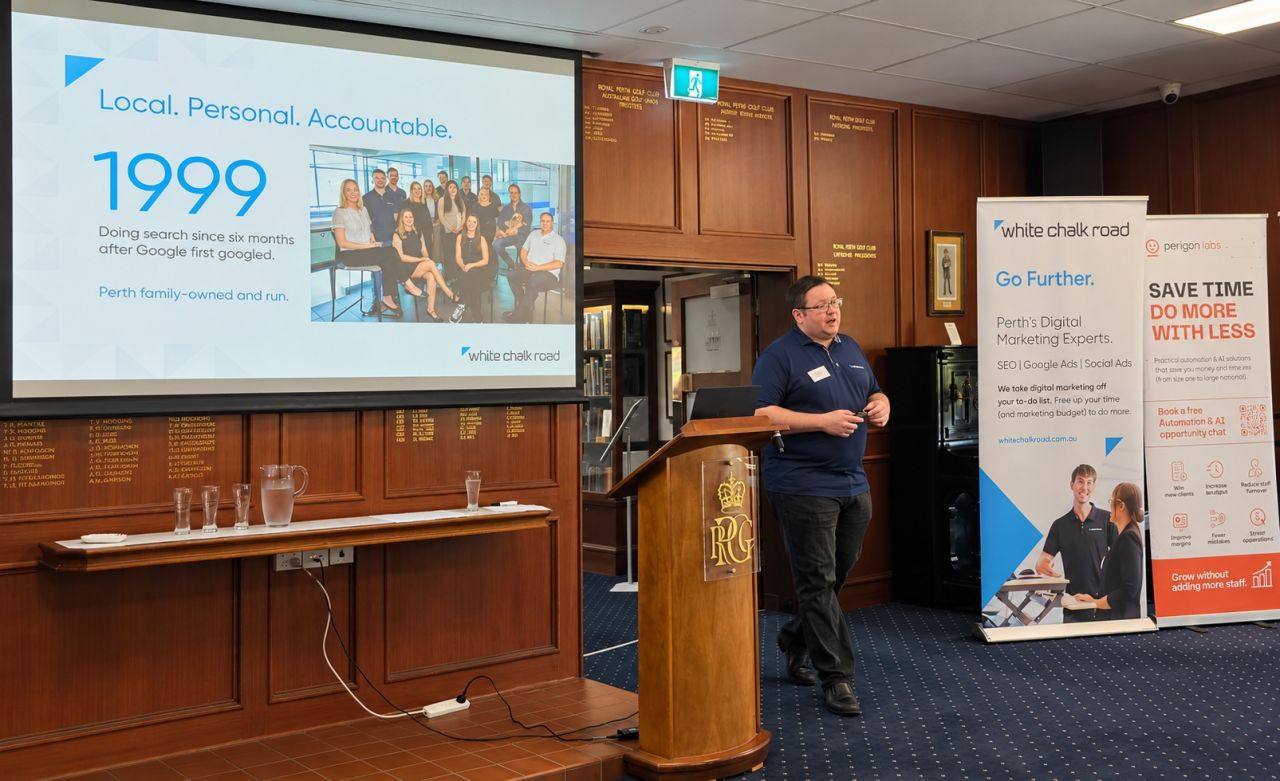
Recently, the team at White Chalk Road teamed up with Perigon Labs to host a morning session at the Royal Perth Golf Club titled “More Growth. Less Grind: AI for Business Acquisition and Delivery.”
Alongside MC Caroline Armstrong, Strategy Director Alex Hamilton from White Chalk Road, Perigon Labs CTO Simon Peirce, and Perigon One CEO Jason Willison unpacked how artificial intelligence is rewriting the playbook for business acquisition and internal operations.
If you weren’t able to join us over breakfast on the day, here is a recap of what we covered, how search has changed, and the best ways your business can harness AI for genuine growth.

Session One: Attract – The shortlist is now written by AI
In the first session, Alex Hamilton, Strategy Director at White Chalk Road, unpacked how search has shifted and what you need to do to be found in AI Search.
He started by looking at how buyers search today. When someone in Perth wants to upgrade their home or find a tradie, they don’t necessarily hunt through traditional Google search results the way they used to. They ask their preferred AI platform, whether that’s ChatGPT, Gemini, Microsoft Copilot, Perplexity, or Google’s AI Mode.
The shift is stark:
>> Searches became answers.
>> Clicks became citations.
>> Rankings became recommendations.
The reality for modern business owners is blunt: If you’re not in the answer, you’re not in the race.
AI now commands the first two steps of the traditional buyer journey: Research and Compare.
When a user asks an AI platform a specific, multi-layered question, such as “Who is the best property manager in Perth?”, AI platforms don’t just hand over a list of blue links. They conduct the research, weigh your business up against local competitors, and formulate a direct comparison.
By the time a prospect clicks through to your website, your site’s job has changed. It no longer does the primary selling; instead, your website validates the choice.
SEO vs. GEO: Winning the race
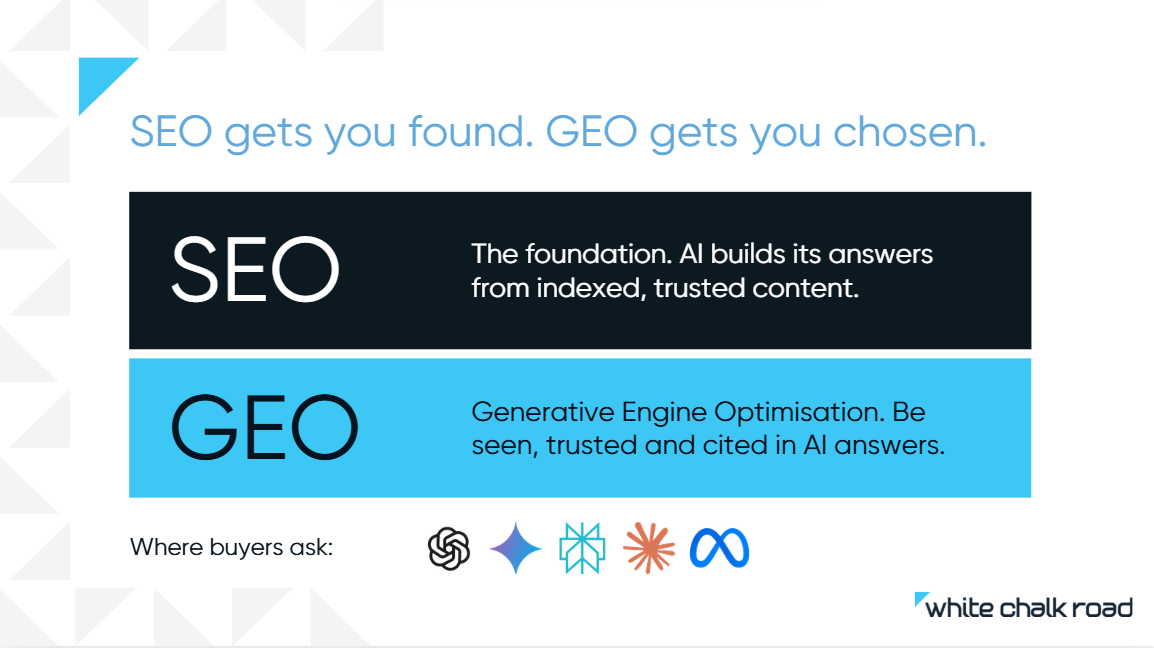
To capture this new landscape, businesses need to master both SEO (Search Engine Optimisation) and GEO (Generative Engine Optimisation):
SEO is the foundation: AI builds its answers from indexed, trusted content. You still need technical excellence, speed, and visibility.
GEO gets you chosen: Generative Engine Optimisation ensures your brand is seen, trusted, and explicitly cited inside AI answers.
To win the research phase, you need to go specific (one detailed page per service), go deep (answer every single question a customer might ask), and go broad (use the actual phrasing and vocabulary your customers use).
To win the comparison phase, you must feed AI the right raw materials:
- Entity Data: Clear ABNs, registered locations, and team details structured cleanly on your site.
- Fresh Reviews: Detailed customer testimonials that AI models can quote directly.
- Reddit & Forums: Authentic mentions in real conversations across the web.
- Podcasts & PR: Local press and media appearances that establish authority.
- Comparison Pages: Explicitly laying out what makes your offering unique.
- Differentiators: Plainly stating why you stand out from the crowd.
Alex left the audience with a practical takeaway to help get found in AI Search:
Build an AI-ready ‘About Us’ page on your website. Map out your foundation, your people, your track record, and your differentiators, then test it by asking AI directly: “Who is [your business]?” Fix whatever it misses or gets wrong.
Session Two: Deliver – Is your business ready for AI?
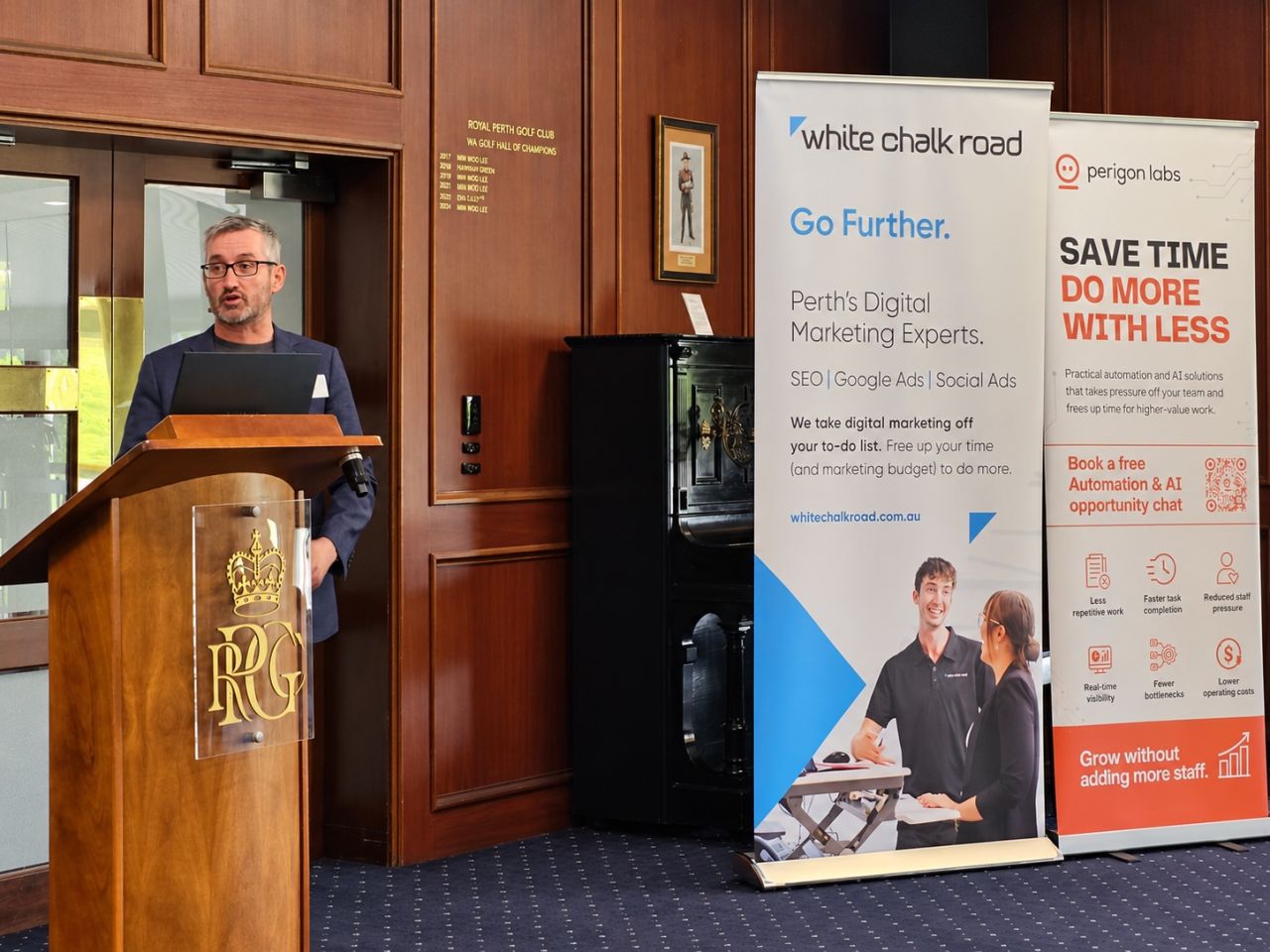
In the second session, Simon Peirce, CTO at Perigon Labs, outlined how to use the right AI systems to streamline your business operations.
Once a customer’s mind is made up through AI research and they finally submit an enquiry, the baton passes from marketing to operations. How quickly and reliably you follow up is no longer just a marketing question; it’s a core systems and processes question.
Everyone is being told they need AI, but the better question is: Is your business ready for it?
The core idea: AI is a multiplier
AI doesn’t fix a broken process; it simply accelerates whatever shape your process is already in:
Good Systems × AI = Speed and better results. Work goes out faster, with fewer errors and more time back for your team.
Messy Systems × AI = More fires, faster. You multiply your existing mistakes at scale.
Many business leaders assume their staff see AI as a threat to their jobs. In practice, when implemented correctly, AI acts as the ultimate behind-the-scenes administrative assistant. It takes over the repetitive grind, such as data entry, pulling together pricing for quotes, chasing follow-ups, and synchronising data between your HR, CRM, ERP, and accounting platforms, freeing up your human workforce to focus on the high-value conversations, nuanced judgment, and personal service that clients truly value.
Real-world automation in action
Simon shared compelling examples of how businesses are applying this right now. Take the classic challenge of collecting leads at an industry trade expo or networking event. Instead of business cards sitting in a pocket or lingering in an unorganised inbox, a simple workflow allows a team member to snap a photo of a business card.
AI reads the details (name, company, role, phone, and email, flagging any unclear data rather than guessing), checks for duplicates, pushes the clean data straight into the CRM, and fires an instant confirmation back to the team chat—all before the representative has even left the exhibition stand.
Similarly, when teams attempt to build custom helpers in AI, such as payroll automation tools, guardrails are vital. One contractor team built a payroll assistant in Copilot that balanced a full week’s pay to within a couple of cents, but required structural partitioning (splitting prompts into stages, establishing a single source of truth, and instituting proper checks) to prevent fragility and drift.
The three-question readiness check
Before introducing AI into any workflow in your office, run it through this quick test:
- Can you explain it step by step? (If you can’t write it down, AI can’t follow it).
- Is the information in one place? (Not scattered across three separate inboxes and someone’s memory).
- Does it happen the same way every time? (Consistent work automates brilliantly; complex exceptions still require human hands).
If you get three “yeses,” that process is your prime candidate for automation.
Keeping it safe and taking the first step
Following the individual keynotes, MC Caroline Armstrong hosted a panel discussion featuring Alex Hamilton, Simon Peirce, and Jason Willison (CEO of Perigon One).
A central theme of the Q&A was governance and security, and how to innovate rapidly with AI while keeping sensitive client data secure, avoiding data breaches, and maintaining oversight.
The consensus from the panel was clear: successful AI adoption isn’t about management mandates imposed on a resistant workforce. It involves building it with your team, identifying where the daily friction lives, and putting human guardrails around automated workflows.
Want to learn more about how to reach and retain your ideal clients in AI search?
If you’re looking to turn AI from a buzzword into a practical driver of growth and efficiency in your business, you don’t have to figure it out alone.
Contact our expert team at White Chalk Road for a discovery session on the best way to reach your audience.
Reach out to the teams at White Chalk Road or Perigon Labs to map out your digital presence and operational workflows.
Let’s make sure AI is multiplying the right things in your business – more growth and a lot less grind.